

The Wild is Always Ready
An Artist Chat by Lisa M. Johnson with Deborah Rutherford on the poetry of redemption and the beauty of surrendering


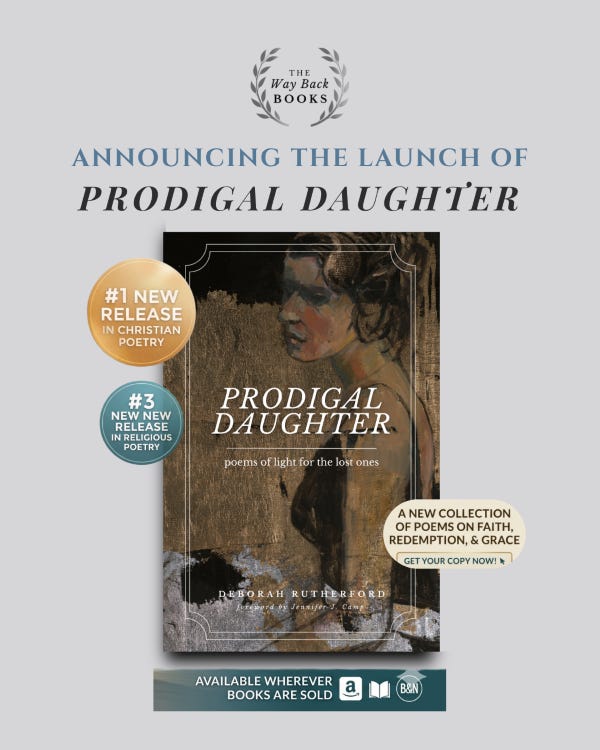
Lending a voice to the journey from Broken to Beloved. 🕊️ Join me today for a special interview by Lisa M. Johnson with me, Deborah, and Prodigal Daughter: Poems of Light for the Lost Ones. If this message touches you today, please place a heart in the comments. It’s a small gesture that helps my writing reach more weary hearts with the hope of Jesus. Also please follow and subscribe to the lovely Lisa M. Johnson:
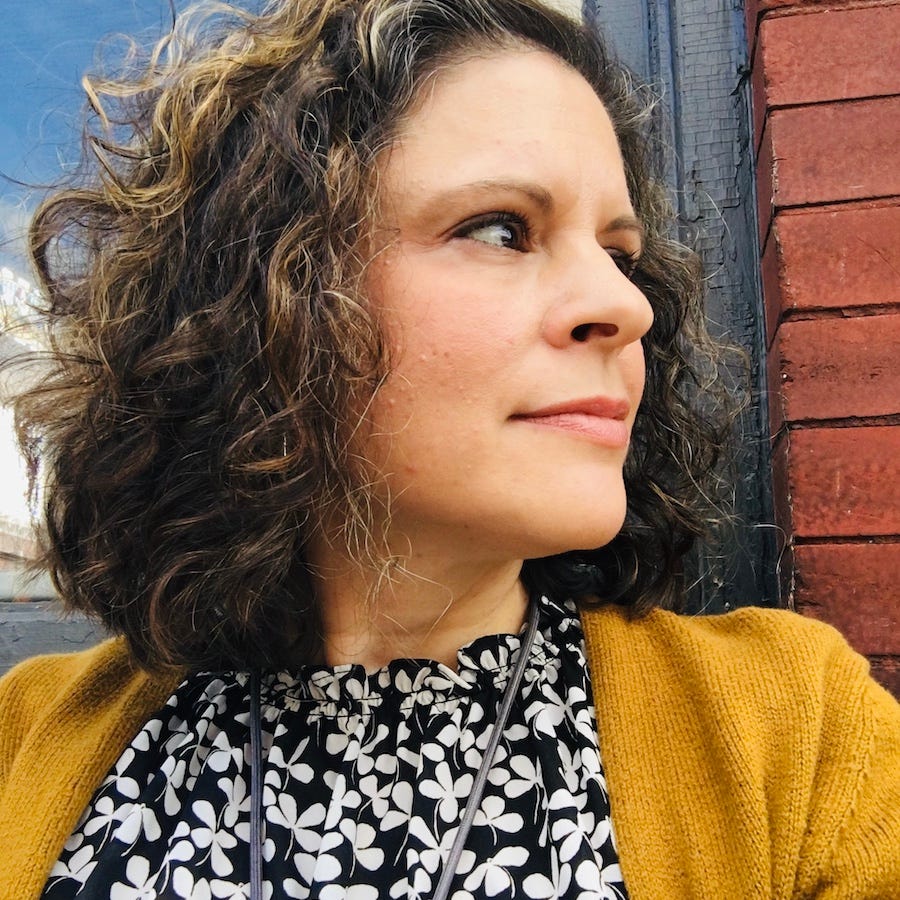
“The wild is always ready to take back the city, like a red-weathered barn weeping...” — Deborah Rutherford
Welcome to what is proving to be one of the favorite parts of writing for me; getting to chat with other writers and poets! As Mary Oliver would say, “to write well it is entirely necessary to read widely and deeply. Good poems are the best teachers. Perhaps they are the only teachers.”
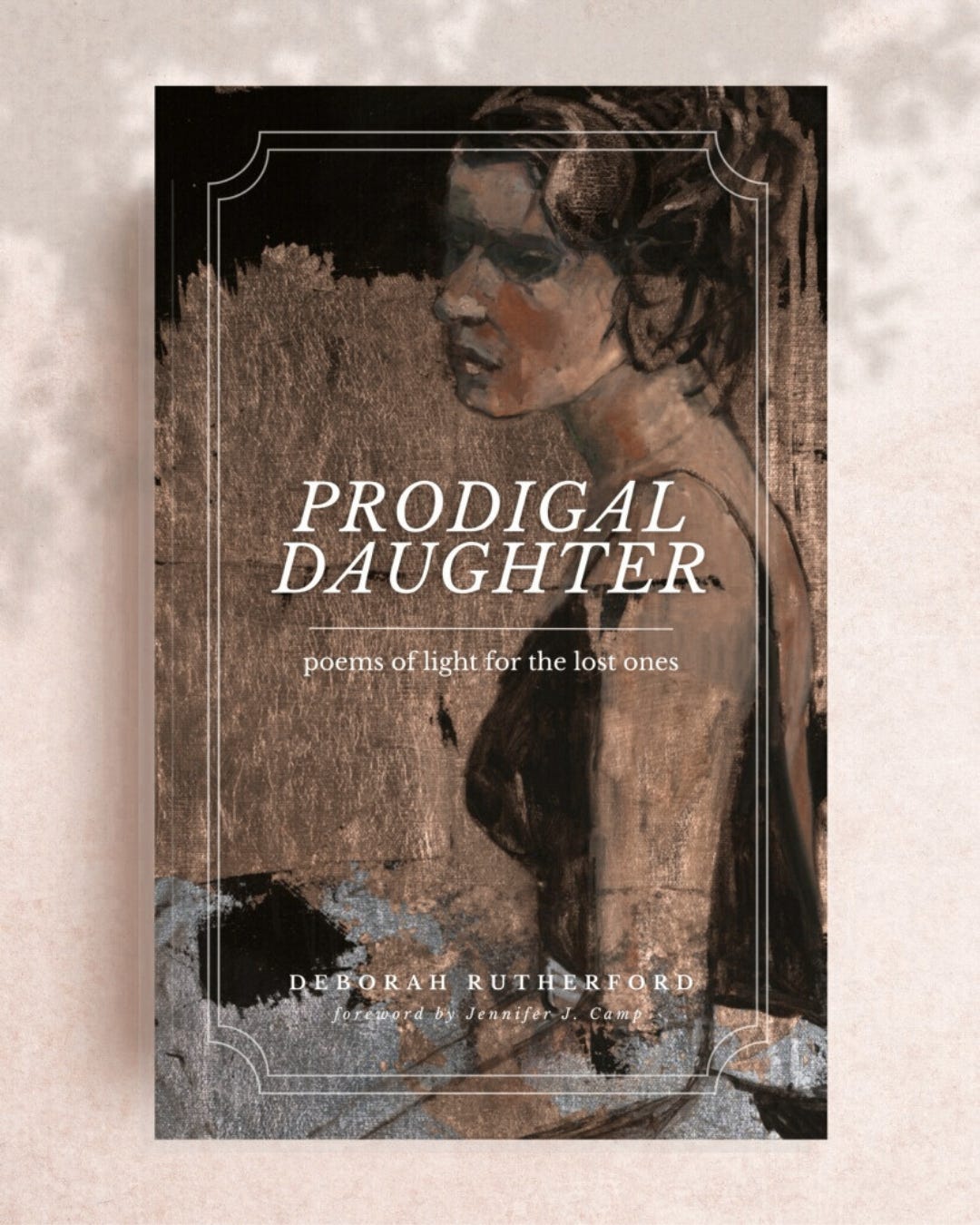
As I sat down to chat with Deborah, debut author of the gorgeous “Prodigal Daughter: poems of light for the lost ones,” with The Way Back Books, I realized what an amazingly unique gift this is to actually chat with her. Can you imagine if we were able to sit and chat with Mary Oliver herself—Rilke, Dickinson, Yeats, Whitman or Poe? To linger over and inquire about a specific poem, asking all the burning questions; that would be a dream!
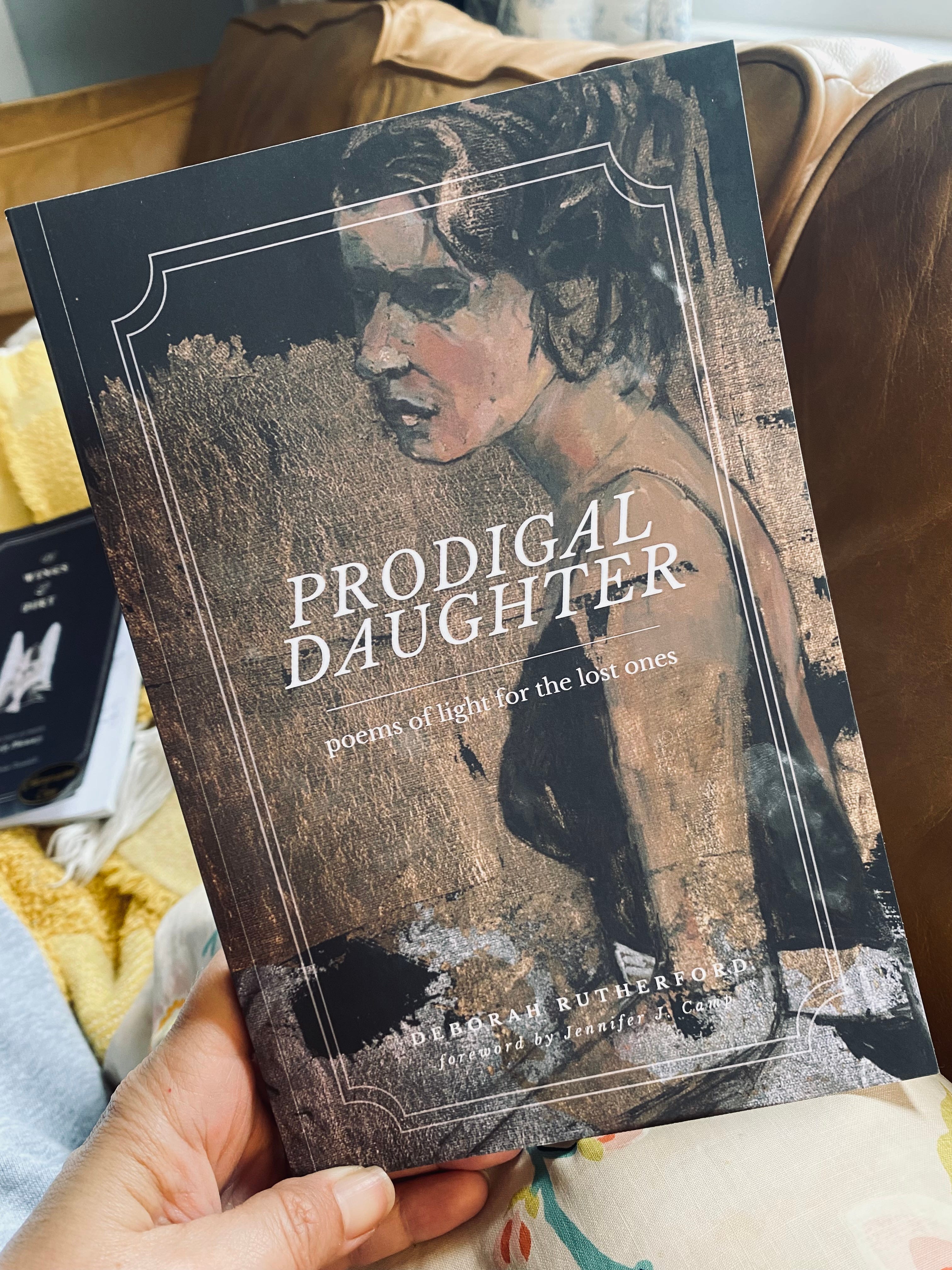
Well today, my readers, you are in for a treat. I read through Deborah’s collection over a weekend and savored each piece, threading the story of her beautiful life and selected my favorite to share with you today; Surrender. I enjoyed my chat with Deborah immensely; how rich and personal it was! But first, Surrender.
SURRENDER

I.

The wild is always ready
to take back the city,
like a red-weathered barn weeping,
swathed in moss and lichen
with high grass shooting through
abandoned posts.

II.

An emerald blanket of kudzu
shrouded the neighborhood
like ancient temples in the jungle—
jewels long gone
surrendered to the wild.
Almost holy,
as nature’s earthy scent
bent what we left behind
into works of art.

 III.

Trees spurted, and vine foliage bedecked
the abandoned buildings
as feathered flocks resettled.
Wolves, wild horses, and boars
roved the rampant forest,
where radiation and no-trespassing signs
chased man away.
Yes, the wild
reclaimed its place.

IV.

The night awakened,
and I slipped out the front door
to retrieve the mail.
But the deer were in the yard,
and our eyes met,
so I decided to go back inside—
for theirs was the outside,
in the nocturnal,
grazing under
an almost full moon.
Ah, “like a red-weathered barn weeping,” —that was the line that told me I was going to become fully engrossed on this page!
LISA: Welcome to In The Quiet, Deborah! So, tell me, what was the spark or genesis of this poem? Was there a specific image, word or moment that compelled you to write it?
DEBORAH: I was so excited to first write this poem for The Way Back To Ourselves Fall Journal Theme, 2024 Wendell Berry/The Peace of Wild Things. What first came was the opening line, “The wild is always ready to take back the city,” because I live in a city in Georgia that was built on a drained swamp and I daily see how quickly the swamp wants to return. It shows me how much alive God’s creation of nature is.
Then I started researching the different places the wild takes back. The second stanza captures the mystery of evasive vine kudzu that has left both modern neighborhoods and ancient jungle cities encapsulated forever by its vine blanket.
Then in stanza three, we have the Chernobyl Nuclear Power Plant, where though man can’t return due to radiation, animals and plant life have and have evolved to thrive. I find this incredible.
By the fourth stanza, I have made peace with the wild, by surrendering to God what is his; in that the wild and I share the outside together, but at night, it belongs to them. You see, I live in a city built on swamp land with woods and it is a designated, protected greenbelt with herds of deer. It’s a beautiful place and way to live; one that is reminiscent of our Eden-life, once and our future one as well.
LISA: What was your personal experience or the emotions that were produced as you were writing and crafting this poem?
DEBORAH: This poem was one of sheer delight, of God teaching me about the wild and how as man, we can live together in harmony, but one day, we will know true harmony together. In writing this poem, I felt a lot of curiosity, yet also sadness and anger about the parts of earth that we have destroyed. Yet in awe, God can restore even what man has done. My book is my redemption story in verse, which shows how God redeems all the broken pieces of my life and to see this redemption in creation as well, shows me how God is redeeming everything for his glory. It’s all about redemption, where God is redeeming everything for his glory, even our pasts, what we leave behind, even the wild.
LISA: Yes, I share those emotions as well; the anger and sadness, and even my own part I have contributed to, but also the hope for what could be redeemed. Was there an intended resonance you desired for the reader? Or an image you wanted your reader to connect with? Is there an underlying message or image you are worried the reader might miss?
DEBORAH: I desired for the reader to walk away with a feeling of wonder of God and how he is in control of everything, man, the wild (nature) and how one day he will restore us all fully to live in a beautiful new Eden.
LISA: I agree. I love the creative nature you’ve tapped into and the awareness of the cycle of a God who has been bringing our “chaos into order, chaos into order” repeatedly, for the infinity of times. Which one line in this poem is the most significant to you and why? Do you have a “darling”?
DEBORAH: The opening line “The wild is always ready to take back the city,”…. just gets me every time. I think we can feel as if we are separate from creation and I believe God wants us to be a part of creation. That’s why it’s so beautiful and powerful. I think the seasons, cycles, the magnitude of the skies, the oceans, the mountains, all point to this. And if we are only in the city, we lose a part of ourselves.
LISA: Tell me more about the line, “Yes, the wild reclaimed its place” in the third stanza.
DEBORAH: As I looked for places that the wild reclaimed, I came across the haunting images of the Chernobyl Nuclear Power Plant accident in 1986 in Ukraine. Though man cannot survive there, the area has become a wildlife refuge, due to lack of human activity in the exclusion zone. So, God has made a way for the wild to reclaim its place. I find it interesting that man can’t return (or not yet) but ‘the wild’ can.
LISA: So intriguing; I was drawn to look up some information about this as well and found that though radiation initially harmed local animals, despite this, the lack of human presence has allowed wildlife populations to thrive, with many species adapting over 40 years to survive in the contaminated zone.
So, was there a word or phrase you debated and what did you finally decide on? And tell me the importance of or decision to create the roman numeral stanzas.
DEBORAH: The words came fairly easy in this one, so I don’t remember if there was one. It was more of like a treasure hunt and along the way each word revealed itself.
The roman numerals help create a flow from one stanza to the next to build upon the theme of God restoring the wild and surrender on my part, to be at peace with the wild and they with me.
LISA: Yes, the last stanza, got me! What a turn or volta it was, as I felt the scenes unfolding outside of me, as an onlooker, until you (or the deer) are looking straight into my eyes now! I loved that ending stanza.
How do you feel about the way this poem fits into the rest of your collection, “Prodigal Daughter”? I honestly felt that it stood out as a consecrated poem from the others.
DEBORAH: Thank you and I love that. In this poem, and in this whole chapter, titled, “Awakening,” I wanted to show how God is present with us from the beginning in his forming of us, until now. But, life happens and often we can’t feel his presence even though he is here. He shows himself in unique ways that speak to each of us of his presence, so that we can encounter him. I call it his love song pursuing and wooing us home. For me, he has always spoken to me through nature, the sky, the trees, flowers, animals. Creation is one of the ways he reveals himself. And why this is so important, and as you say, a consecrated poem, is that if we surrender to his awakening, his call, his encounter, we find ourselves in the presence of our God almighty and that’s pretty amazing. And that is when we see our God and his love, and our need for a Savior; he being that Savior.
LISA: Why “Surrender” as the title choice?
DEBORAH: To me, surrender is such an important part of our Christian walk. So, as I wrote this poem and pondered about creation, the wild, the why, the how… God revealed how surrender is something that is in creation too. It is for us and everything was created by Jesus and everything is for him, for his honor and praise, as we read in Colossians—
For by Him all things were created that are in heaven and that are on earth, visible and invisible, whether thrones or dominions or principalities or powers. All things were created through Him and for Him. Colossians 1:16
What an honor to have you, Deborah, as our special guest poet today!
Thank you for sharing the wild, silky, and textured part of yourself that made this poem, and these words an embodied experience for us.
“A final observation. Poetry is a river; many voices travel in it; poem after poem moves along in the exciting crests and falls of the river waves. None is timeless; each arrives in an historical context; almost everything, in the end, passes. But the desire to make a poem, and the world’s willingness to receive it—indeed the world’s need of it—these never pass.
If it is all poetry, and not just one’s own accomplishment, that carries one from this green and mortal world—that lifts the latch and gives a glimpse into a greater paradise— then perhaps one has the sensibility: a gratitude apart from authorship, a fervor and desire beyond the margins of the self.” Mary Oliver
If Deborah’s work resonated with you, we’d both love to hear from you! And don’t forget to get your copy of Deborah’s complete collection today; it’s gorgeous! I’ll be picking up an extra copy or two at the Cultivate Writer’s Retreat in June to replace the one I’ve brought to share at the jail already! What a joy to see your words and hope go out and meet beautiful people, wherever they are in the world.
As always, thanks for being here for a few moments in the quiet together,
Lisa
LINKS: Prodigal Daughter: Poems of Light for The Lost Ones The Way Back Books Release Date: April 27, 2026
Amazon Link: https://amzn.to/4cHmtfy
Buy directly from Deborah:
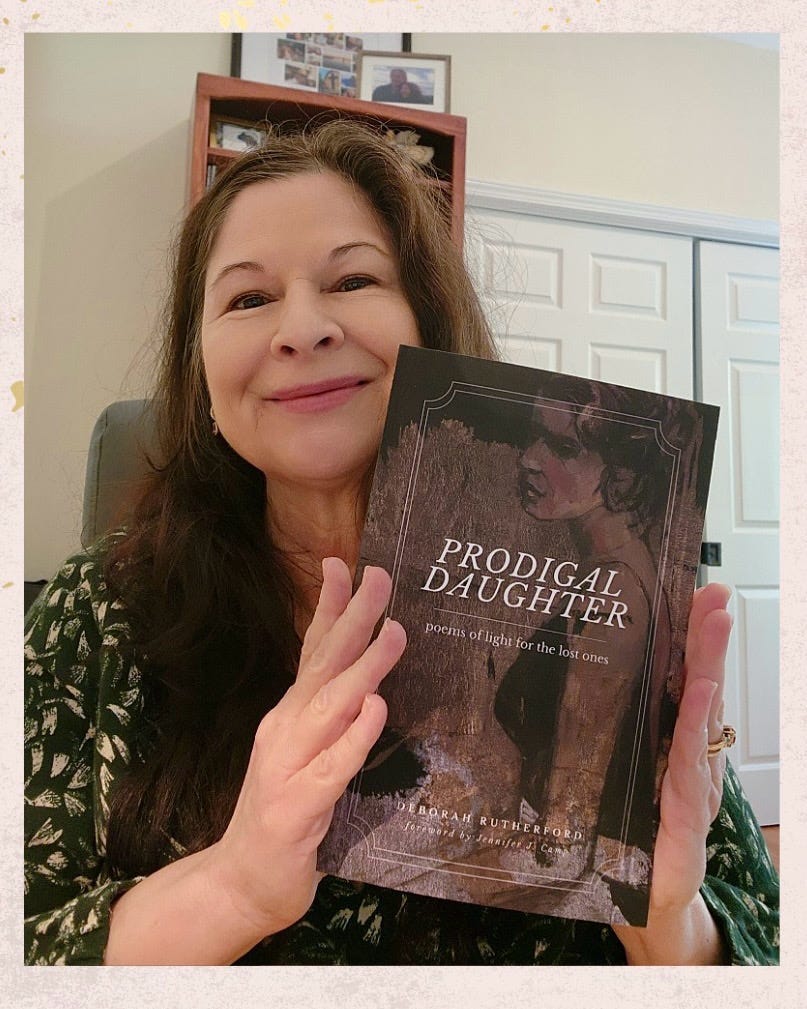
DEBORAH RUTHERFORD is a Christian wife, an award-winning poet, author, speaker, and an Emmy recipient for her makeup artistry in film and television. With Welsh, English, and Mexican roots, Deborah’s diverse heritage informs her perspective on belonging. Deborah’s pilgrimage from the shadows to a life restored in Christ serves as the foundation for her debut collection, Prodigal Daughter. Her work has been published in The Way Back to Ourselves, Vessels of Light, Calla Press, and Prosetrics. A co-author of the Unexpected Blessings series and founder of the Behold-Her Beauty podcast, Deborah is represented by The Blythe Daniel Agency. She writes to illuminate God’s faithfulness and assure every wandering soul that they are unconditionally loved. She lives in Georgia with her husband, Don, where she enjoys singing old hymns and walking under the pines. You can find Deborah’s writing at DeborahRutherford.substack.com and on Instagram deborahrutherfordwrites.
 | A guest post by
|
Lisa, I loved our conversation so much. Getting to talk with you about God, theology, creation and poetry fills my heart.
When you asked, "How do you feel about the way this poem fits into the rest of your collection, “Prodigal Daughter”? I honestly felt that it stood out as a consecrated poem from the others."
And then this poem is "Surrender" and I can't help but be blown away by the way God orchestrates every part of life. It's so beautiful. Thank you for bringing me on to your Artist's chat In The Quiet.
I would love to hear everyone else's thoughts on God, surrendering, and creation. Happy Sunday!
Beautiful poem!